
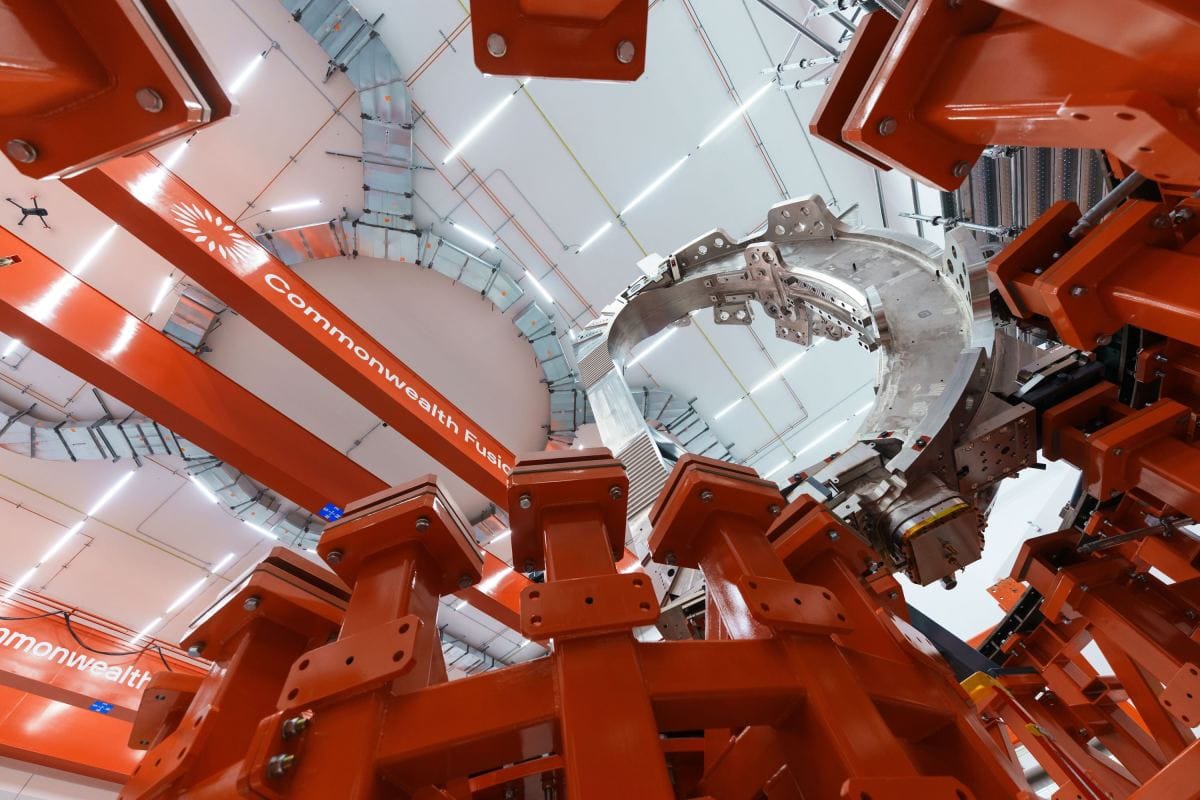
Fusion energy has been talked about for decades. People have said it is the power of the future, but that future always felt far away. Now something important has happened that makes fusion feel real and close. Commonwealth Fusion Systems, also called CFS, has installed a key magnet for its fusion reactor and has also signed a major deal with Nvidia. These two steps together show that fusion energy is moving from ideas to real machines.
This moment matters not just for scientists, but for everyone who cares about clean energy, stable power, and the future of technology.
What is Commonwealth Fusion Systems
Commonwealth Fusion Systems is a startup that came out of research at MIT. The company is focused on one big goal, making fusion energy work in the real world. Fusion is the same process that powers the sun. It joins tiny particles together and releases a huge amount of energy.
Unlike coal or gas, fusion does not produce carbon pollution. Unlike nuclear fission, it does not create long lasting radioactive waste. That is why many people see fusion as the clean energy solution the world has been waiting for.
CFS is building a machine called SPARC. This is a fusion reactor designed to prove that fusion can make more energy than it uses.
Why the reactor magnet matters
The magnet that CFS has installed is not just any magnet. It is one of the most powerful magnets ever built for a fusion reactor. Each magnet is shaped like a large letter D and weighs about as much as a truck. These magnets are used to create a strong magnetic field.
Why does that matter? Fusion needs extremely high heat, hotter than the center of the sun. No solid material can touch that heat. So instead of holding the hot plasma with walls, scientists use magnetic fields to trap it in the air.
The stronger the magnetic field, the better the plasma can be controlled. This makes fusion reactions more stable and more efficient.
CFS is using a new type of magnet made from high temperature superconductors. These magnets can carry massive electric currents with very little energy loss. This is one of the key reasons SPARC can be smaller and faster to build than older fusion designs.
Installing the first magnet shows that SPARC is no longer just a plan. It is becoming a real machine, piece by piece.
What SPARC is trying to prove
SPARC is a demonstration reactor. Its main job is to show that fusion can produce more energy than it consumes. This is known as net energy gain.
If SPARC succeeds, it will be a major breakthrough. It would prove that fusion is not just possible, but practical.
CFS plans to finish building SPARC by around 2026. The first plasma tests are expected in 2027. After that, the company wants to build a full power plant called ARC that could supply electricity to the grid.
Why Nvidia is involved
Alongside the magnet installation, CFS announced a partnership with Nvidia. This deal is just as important as the hardware progress.
Nvidia is known for making powerful chips used in AI, graphics, and simulations. But Nvidia is also building advanced tools for digital simulation, including a platform called Omniverse.
CFS will use Nvidia’s technology to create a digital twin of the SPARC reactor. A digital twin is a virtual copy of a real machine. It behaves like the real thing and updates using real data.
This means engineers can test ideas, spot problems, and run experiments on the digital reactor instead of the physical one. That saves time, money, and reduces risk.
How AI helps fusion move faster
Fusion is incredibly complex. There are many variables that affect how plasma behaves. Temperature, pressure, magnetic fields, and tiny instabilities all matter.
AI can analyze massive amounts of data very quickly. By combining real reactor data with simulations, AI can help scientists find better settings and avoid dangerous conditions.
With Nvidia’s tools, CFS can run simulations that would normally take years and compress them into weeks or even days. This is one of the reasons fusion timelines are speeding up.
AI does not replace scientists, but it helps them learn faster and make better decisions.
Why this matters for clean energy
The world needs more energy, not less. AI data centers, electric vehicles, and growing cities all require huge amounts of power. At the same time, there is pressure to cut carbon emissions.
Fusion offers a rare combination. It can provide steady power day and night. It does not depend on weather. It produces no carbon pollution. And its fuel is abundant.
If companies like CFS succeed, fusion could become a backbone of future power grids.
This is also why tech companies are paying attention. Nvidia, Google, and others see fusion as a way to support the energy needs of future computing.
A shift from science to engineering
For many years, fusion was mainly a science problem. Researchers were trying to understand plasma physics. Today, fusion is becoming an engineering problem.
CFS is assembling real hardware. Magnets, cooling systems, control software, and AI tools are all coming together.
Installing the reactor magnet is a clear sign of this shift. It shows that fusion is no longer just happening in labs. It is being built like any other major industrial system.
What comes next
More magnets will be installed. Systems will be tested. The digital twin will grow smarter as more data comes in. Each step reduces uncertainty.
There are still risks. Fusion is hard. Not every experiment will work as planned. But the progress so far suggests that fusion is closer than ever before.
The Bottom Line
Commonwealth Fusion Systems installing its reactor magnet and partnering with Nvidia is a major milestone. It combines cutting edge hardware with powerful AI software.
This moment shows how clean energy and advanced computing are coming together. Fusion is no longer just a promise for the distant future. It is being built now.
If SPARC succeeds, the world could be on the edge of a new energy era. One where power is clean, reliable, and built using the same tools that drive today’s AI revolution.
For the first time in a long time, fusion feels less like a dream and more like a plan that is actually working.
Also Read: Nvidia wants to be the Android of generalist robotics
